

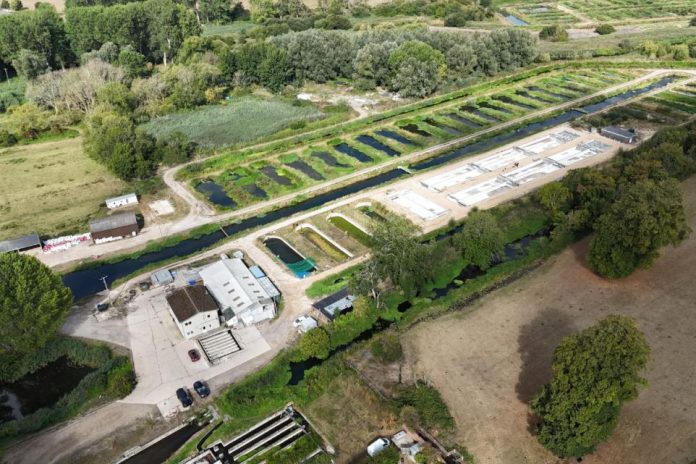
Farmer rejects “factory farming” claims over proposed Wiltshire salmon site.
Coldwater Salmon has defended its proposal to convert a former trout farm near Downton in Wiltshire into a land-based salmon facility, arguing the project will significantly cut water and energy use compared to its previous operation.
The company is seeking permission from Wiltshire Council to build a 3,240-square-metre steel and PVC canopy at Barford Fish Farm, formerly operated by Trafalgar Fisheries. The site used concrete-lined ponds for trout farming until March.
Julian Connor, founder of Coldwater Salmon, said the switch to land-based salmon production was “imperative to support the viability” of the site. He rejected claims from environmental groups that the development would harm the local ecosystem.
“They are confusing sea-based salmon farming, which grows salmon in nets in the sea and has no water filtration and uses chemicals and antibiotics to control parasites and pathogens, with land-based salmon farms, which grow salmon in a closed system recirculating the water and filtering it using a biofilter,” Connor told the Salisbury Journal.
According to Coldwater Salmon, the conversion would halve energy consumption at the site and reduce water usage by 95 per cent. “The recirculating system cleans the water biologically, using bacteria that propagate out of the fish gut and grow on a biofilter,” Connor said. “It is therefore impossible to use chemicals or antibiotics because they would kill the biofilter.”
The company said the new system would use existing pumps, add no new energy-intensive equipment, and generate around half of its power from solar panels and battery storage. It also plans to eliminate fish meal entirely from its feed, using black soldier fly larvae as an alternative protein source.
Connor noted that the World Wide Fund for Nature (WWF) has given salmon produced in closed recirculation systems a “green/preferred” sustainability classification, covering water pollution, resource use, energy, and fish welfare.
The proposals have attracted more than 1,100 public comments since being submitted in July, including objections from the Green Britain Foundation, founded by environmentalist Dale Vince, and the campaign group Foodrise.
Critics say the development represents “factory farming” and have raised concerns over energy demand, fish mortality and feed sourcing.
Wiltshire Council is currently reviewing the planning application.