

Hinkley Point’s £700m ‘fish disco’ raises questions over cost of green mitigation.
Britain’s most expensive nightclub may turn out to be underwater.
According to a government-commissioned review, Hinkley Point C’s suite of “fish protection measures” will cost more than £700 million and is expected, on the developer’s own modelling, to save 0.083 salmon and 0.028 sea trout per year.
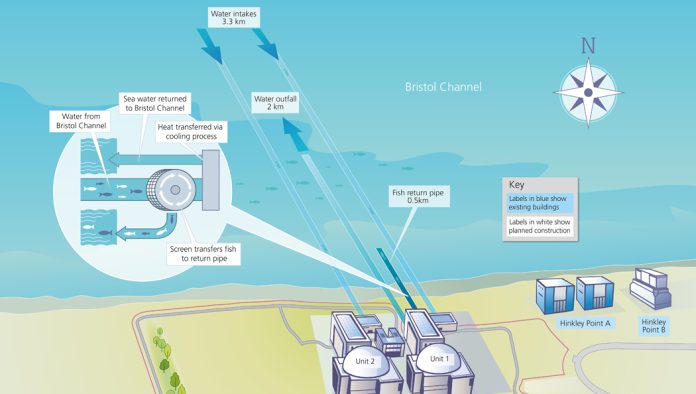
The Somerset nuclear plant, still under construction, will open with more mitigation for marine life than any other power station in the world, after ministers agreed stringent planning conditions. The package includes an acoustic fish deterrent, nicknamed the “fish disco”, a fish recovery and return system, and low-velocity intake heads.
EDF’s modelling suggests the full system will spare six river lamprey, 18 allis shad and 528 twaite shad annually – “or possibly fewer than 100 twaite shad on more recent estimates” – alongside the fractional benefit for salmon and sea trout, according to The Times.
The figures are contained in a review by John Fingleton, former chief executive of the Office of Fair Trading, on why building nuclear power in the UK has become so costly and complex. He highlights what he describes as mitigation measures “that exceed the actual level of risk”, driven by environmental designations and the demands of statutory nature bodies.
The nuclear sector is not alone. HS2, the UK’s bloated high speed rail project, has spent more than £100 million on a bat tunnel in Buckinghamshire to shield a population of 300 Bechstein’s bats from passing trains. Fingleton calculates that this “implicitly valued Bechstein bat lives at above £300,000, one sixth of what HM Treasury values a human life”.
The numbers are now feeding into a wider political argument over how far environmental conditions should be allowed to drive up costs for major infrastructure.
Speaking at the CBI conference in London, Zia Yusuf, head of policy at Reform UK, said: “I love fish, I love all animals, but [at] Hinkley Point C £700 million was spent on the whole fish protection programme, which works out at £280,000 per fish.
“So when we talk about tough decisions needing to be made and there not being enough money for British pensioners to heat their homes, forget about which humans in society need to pay the consequences of that: currently fish or newts or bats have superior rights, frankly, to many humans in this country.”
Ed Miliband, the energy secretary, is pressing ahead regardless, promising a “golden age of new nuclear” and arguing that reforms now under way will deliver projects “in a safe, affordable way”.
For now, Hinkley Point C is set to proceed with a mitigation package that places a striking price on the head – and the gills – of a very small number of fish. Whether investors and bill-payers feel they are getting value for money from the £700 million “fish disco” will be another matter.