

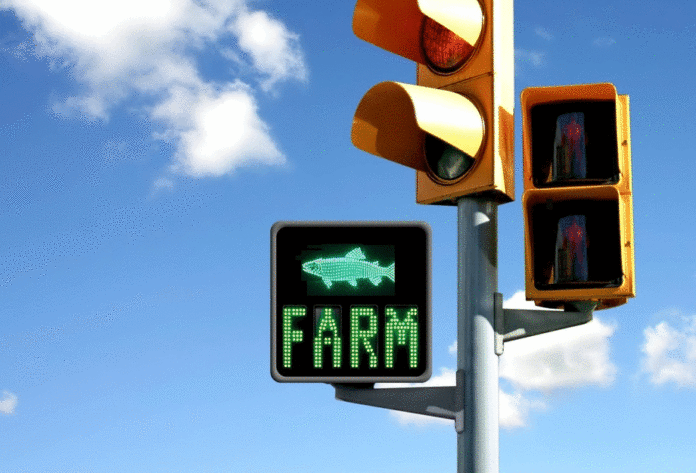
Government publishes 2025 lice impact reports for traffic light system.
The Norwegian government has published new reports on the impact of salmon lice on wild salmon in 2025, providing the technical basis for the next round of decisions under the traffic light system for salmon and trout farming.
The reports, prepared for the government by expert groups and released by the Styringsgruppen on 1 December, are available at trafikklyssystemet.no, together with previous years’ documentation.
Fisheries and oceans minister Marianne Næss said publication of the technical material now allows the industry to comment before the government decides on new colour classifications for the 13 production areas. The colour decisions, which determine whether biomass in each area may grow, must be reduced or held stable, will be made in the first quarter of 2026.
How does Norway’s traffic light system for salmon farming work?
Researchers assess that in 2025 there is high risk from lice impact in one production area (PO3), moderate risk in nine production areas and low risk in three areas (PO1, PO12 and PO13). All production areas have the same risk classification in 2025 as in 2024.
Under the 2015 white paper on predictable and environmentally sustainable growth in Norwegian salmon and trout farming (Meld. St. 16 (2014–2015)), identical results in two consecutive years give a predictable outcome, and no additional assessment is normally carried out. Where monitoring shows a change in impact, the authorities are required to make a broader assessment based on overall environmental status and may also consider socio-economic consequences.
The Styringsgruppen plans to hold a dialogue meeting with stakeholders in early January, where it and the Expert Group will present the main findings and take short professional inputs and clarification questions. The Norwegian Institute for Nature Research (NINA) will also present its work on lice impact assessments for sea trout and results for 2024 and 2025.
NINA has developed a model for lice impact on sea trout and has calculated effects for 2021 and 2024. A model calculation for 2025 has been ordered by the ministry and is expected to be ready in early December. The model is not yet a full indicator, but is comparable to the models that feed into the existing indicator for lice impact on wild salmon.
The ministry is considering how NINA’s model can form the basis for a future sea trout indicator aligned with the salmon indicator. A full sea trout indicator could be included in impact assessments for production areas from 2026 at the earliest. If assessments are available for 2026 and 2027, sea trout may be included as an indicator in the traffic light colour decisions from 2028.