

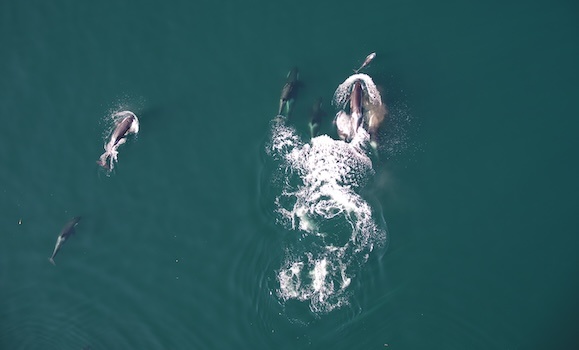
Video and audio data suggest top predators are co-operating rather than competing.
Scientists off the coast of British Columbia have documented behaviour suggesting northern-resident killer whales and Pacific white-sided dolphins are working together to forage for Chinook salmon.
Researchers from Dalhousie University, the University of British Columbia, the Hakai Institute and the Leibniz Institute attached suction-cup biologging tags to resident killer whales in August 2020 and deployed drones from a 16 metre research vessel to record fine-scale movements and vocalisations.
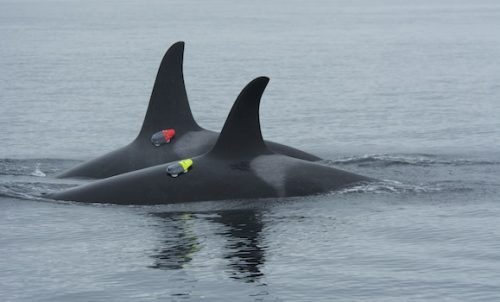
Footage and audio revealed the whales and dolphins chasing salmon at the surface and synchronising movements at depth. Underwater video showed killer whales moving toward dolphins and following them down the water column while both species produced echolocation clicks associated with prey search.
“We were all just like, ‘What?’” said Dr Sarah Fortune, lead author of the new study. “Whenever we can apply new technologies that can push the limits of available data, inevitably we end up with new insights that show us the lack of understanding we previously had.”
The study proposes that killer whales may be eavesdropping on dolphin echolocation to help locate large Chinook salmon, prey that dolphins cannot swallow whole. The dolphins in turn appear to scavenge salmon fragments discarded during feeding.
Drone pilot Keith Holmes of the Hakai Institute, who first observed the behaviour during fieldwork, said it was clear from the aerial footage that both species were actively foraging together.
Across the study, researchers recorded 258 events of dolphins travelling near the head of tagged killer whales. All whales involved in such interactions were engaged in foraging behaviours including searching for, killing and consuming salmon. No aggression or avoidance was observed between the species.
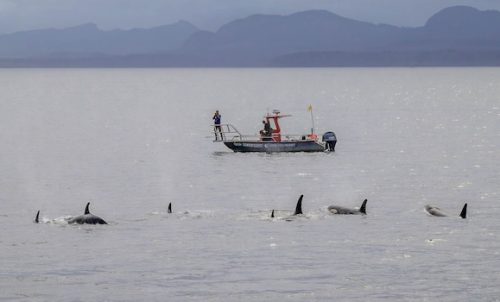
Photo: Andrew Trites
“The strategic alliance we observed is extraordinary,” said Dr Andrew Trites of UBC’s Institute for the Oceans and Fisheries. “By working together, killer whales can conserve energy and increase their chances of finding large Chinook salmon. In return, the dolphins gain predator protection and access to scraps. It is a win-win for everyone involved.”
The findings, published in Scientific Reports, highlight the ecological significance of interspecies associations and their potential role in shaping marine food webs. The authors note that further work is required to understand how widespread the behaviour is and whether co-operative foraging confers measurable benefits to either population.