

Feed trials to examine impact of mussel-based ingredients on salmon health.
Researchers at Havforskningsinstituttet will test whether blue mussels can be used as a sustainable ingredient in salmon feed as part of the Mussel Up project.
The project will examine how the inclusion of mussels in salmon feed affects fish growth, health and welfare.
“We will investigate whether mussels are safe and nutritious for salmon, and whether processing preserves their nutritional value,” said marine researcher and project manager Ikram Belghit.
Norway’s long coastline gives the country strong potential for blue mussel production, according to Belghit.
“Norway’s extensive coastline means the country may have the greatest potential for blue mussel production in Europe,” she said.
By 2034, all farmed fish feed in Norway is expected to come from sustainable sources. At the same time, the share of domestically produced feed ingredients is to increase from around 8 percent today to 25 percent.
“Today, most ingredients used in aquaculture feed are imported,” Belghit said.
“That is why we are exploring the possibility of using mussels in salmon feed.”
Blue mussels are a low-trophic species and require limited resources to produce.
“Mussels are easy to cultivate, do not require complex technology, take up little space and remove excess nitrogen, phosphorus and carbon from the water,” Belghit said.
“In addition, they are nutritious and readily available locally, which could make them a good candidate for more sustainable feed production.”
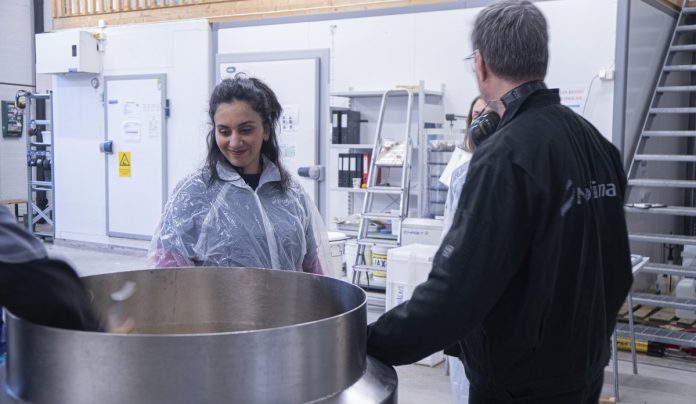
Processing remains a key challenge. Over the past two years, researchers have tested several methods for utilising fresh mussel meat. Different mussel-based feed products have been developed at Nofima’s feed technology centre and evaluated for use in fish feed.
“Mussels have a high water content, which makes preservation and processing demanding,” said Tor Andreas Samuelsen, senior researcher at Nofima.
“But we have now identified the most promising production method.”
Some processing is required to preserve the product and make it suitable for use in fish feed, but excessive processing can reduce product quality and increase energy consumption. The aim is to produce a high-quality mussel meal in the most cost-effective and sustainable way possible.
The final stage of the project will involve feeding trials with salmon.
“We will assess how the feed affects growth, health and welfare in salmon. This is crucial in determining whether mussels can be used commercially,” Belghit said.