

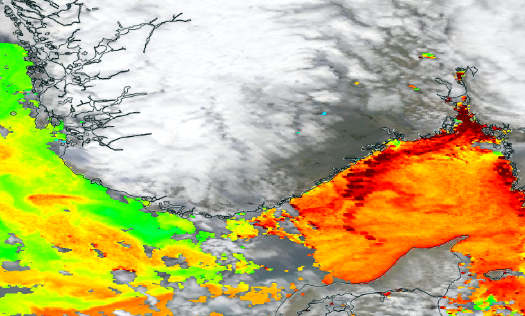
Algae risk declines in southern Norwegian salmon farming areas.
The risk of harmful algae blooms linked to Pseudochattonella has declined in several salmon farming areas along the southern Norwegian coast, according to a status update from the Institute of Marine Research (HI) covering conditions to March 31.
The algae species has been detected in production areas 1 to 3, but concentrations have fallen significantly in recent weeks. Based on monitoring data and incoming reports, the risk is currently assessed as low in production areas 2 and 3.
In production area 1, the risk is still considered moderate, although measured densities have declined and the species was not detected in samples taken at Arendal on March 31. Researchers said the possibility of transport from inner parts of the Skagerrak cannot be ruled out.
Satellite data from March 30 showed elevated phytoplankton biomass in parts of the Skagerrak, but HI said it has no data confirming that these blooms are Pseudochattonella.
Weather and current conditions in the region are expected to slow coastal transport and may reduce the likelihood of further blooms in the coming days.
HI advised salmon farmers in affected areas to monitor fish behaviour and mortality and report any changes through the institute’s algae monitoring system.