

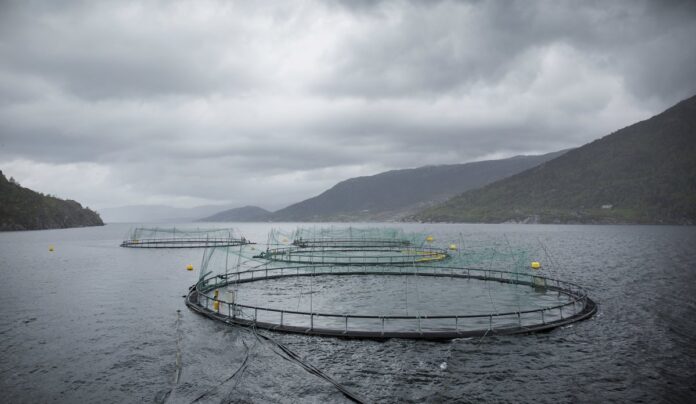
Norway’s Institute of Marine Research has mapped how sea lice spread between salmon farming sites, identifying which facilities contribute the most and least infection pressure to neighbouring farms.
The work was carried out following a request from the aquaculture industry and is published in a new report covering 2024 and 2025.
Researchers used modelling based on reported sea temperatures, female lice counts and fish biomass at individual sites to estimate the production and spread of sea lice larvae between farming locations.
The institute said the same modelling framework is already used to assess how sea lice from aquaculture sites affect wild salmonids.
According to research director Ingrid Askeland Johnsen, the results could help producers make strategic decisions about where to focus mitigation measures.
The report found that sea lice levels were particularly high last year after record warm sea temperatures persisted into autumn, creating favourable conditions for the parasite over an extended period.
The modelling also showed significant day-to-day variation in how lice spread through fjord systems due to currents, tides, wind and freshwater flow.
The report did not assess infection pressure on wild salmon, sea trout or Arctic char.
Researchers noted that around 40 farming sites have adopted submerged cage technology to reduce lice levels, although no national register exists tracking where the systems are deployed.
The report, Smittevegar lakselus – Mellom anleggslokalitetar i 2024 og 2025, was authored by Ingrid Askeland Johnsen and Anne Dagrun Sandvik.