

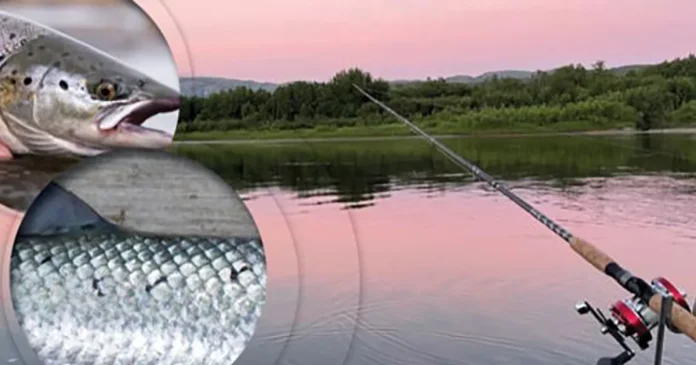
Deep-learning tool distinguishes wild and farmed salmon from scale images.
Researchers in Norway have developed a deep-learning model that can distinguish wild from farmed Atlantic salmon using images of fish scales, offering a potential new tool for monitoring escapees and protecting wild stocks.
The work, published in Biology Methods and Protocols by Oxford University Press, uses a convolutional neural network trained on almost 90,000 images of salmon scales sourced from the Norwegian Veterinary Institute and the Norwegian Institute for Nature Research. The dataset spans hundreds of rivers across Norway and extends back to the early 1930s, with farmed salmon accounting for around 8.5 percent of the images.
Norway holds the largest remaining wild Atlantic salmon populations while also being one of the world’s largest producers of farmed salmon, with annual production of more than 1.5 million metric tons. Atlantic salmon abundance in the country has fallen by more than 50 percent since the 1980s and is now at historically low levels. Escaped farmed salmon are identified as one of the important drivers of this decline.
Escapes are estimated at around 300,000 fish a year. Farmed salmon can pose ecological and genetic risks to wild stocks by competing for food and spawning habitat, spreading pathogens and parasites such as sea lice, and interbreeding with wild fish. Genetic analyses cited in the study indicate that roughly two-thirds of wild salmon in Norway now carry signatures of interbreeding with farmed salmon.
Scale analysis has long been used to differentiate wild and farmed salmon. Salmon scales, like tree rings, form concentric growth rings whose number and spacing reflect growth patterns. Farmed salmon typically show rapid, steady growth with regularly spaced rings and limited seasonal variation, while wild salmon exhibit more pronounced seasonal differences in their scales due to fluctuating temperatures, prey availability and migration.
Manual assessment of these patterns is time-consuming and costly. The researchers therefore built a standardized image-processing pipeline and trained a convolutional neural network to classify scales by origin, benchmarking its performance against human expert readers and fish of known provenance.
According to the paper, the model can rapidly process scale images and generate predictions with associated confidence scores. It was able to differentiate farmed from wild salmon across most Norwegian salmon rivers between 2009 and 2023 with an accuracy of 95 percent, the authors report.
The study, “Identifying escaped farmed salmon from fish scales using deep learning,” is available from 26 November at: http://doi.org/10.1093/biomethods/bpaf078.