

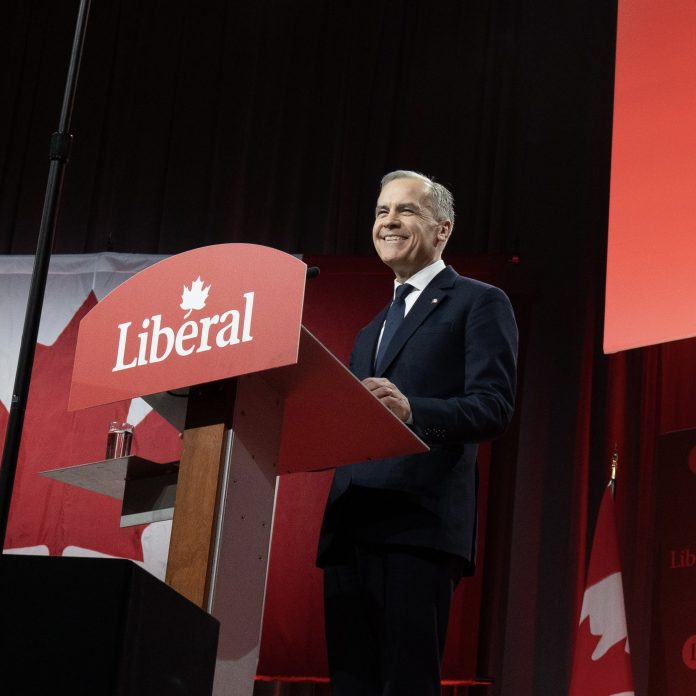
Mark Carney elected as Canada’s next prime minister.
Mark Carney has won the leadership of Canada’s Liberal Party, securing his position as the country’s next prime minister. The former Bank of England and Bank of Canada governor will succeed Justin Trudeau, who stepped down earlier this year following declining popularity and pressure from within his party.
Carney’s victory comes amid heightened tensions with the US, with President Donald Trump recently imposing and then partially reversing tariffs on Canadian goods. In his victory speech, Carney signaled a firm stance against US trade policies, stating that Canada would not allow Trump to “succeed” in undermining its economy. He pledged to maintain retaliatory tariffs on US imports “until the Americans show us respect.”
Carney, 59, won the party leadership in a landslide, securing 85.9% of the vote against three rivals, including former Finance Minister Chrystia Freeland. His election represents a shift toward a more centrist economic approach, with a focus on trade diversification and energy development.
While Carney will initially lead a minority government, a general election is expected in the coming weeks. Recent polls suggest the Liberals have narrowed the gap with the opposition Conservatives, led by Pierre Poilievre, after initially trailing by more than 20 points.
What this means for the salmon industry?
Mark Carney’s strong stance on trade with the US could have significant implications for Canada’s salmon industry, which relies heavily on exports. The US is Canada’s largest market for farmed salmon, and any escalation in trade tensions—particularly if retaliatory tariffs remain in place—could affect pricing, market access, and profitability for producers.
In his victory speech, Carney pledged to maintain Canada’s counter-tariffs until the US “shows respect.” If these measures extend to seafood exports, Canadian salmon producers could face higher costs and reduced competitiveness in their key export market. The US has used trade barriers, including tariffs and labeling requirements, as leverage in disputes, and Carney’s combative approach could increase the risk of further restrictions on Canadian seafood.
At the same time, Carney’s emphasis on economic diversification and reduced dependence on US trade could push the salmon industry to explore alternative markets, particularly in Asia and Europe. His background in finance suggests a pragmatic approach to trade, and it remains to be seen whether his government will negotiate sector-specific exemptions to mitigate risks for key industries, including aquaculture.
Additionally, Carney’s broader economic strategy—supporting clean energy and environmental regulations—could shape federal policies on aquaculture. If his administration aligns with existing plans to phase out open-net pen salmon farming in British Columbia by 2029, the industry may face further regulatory challenges. However, his focus on investment and economic resilience could also lead to increased support for land-based and closed-containment salmon farming as an alternative.