

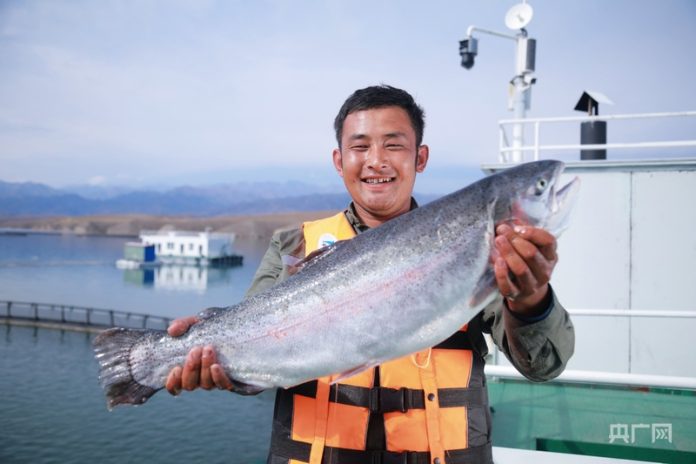
China expands inland ‘salmon’ production as import substitution drive continues.
China is continuing to scale inland production of salmon-type fish as part of a broader push to reduce reliance on imported salmon, according to a state-media report highlighting a cold-water aquaculture operation in Xinjiang.
State broadcaster China National Radio reported that a producer in Nilka County is now producing around 12,000 tonnes of fish annually, marketed domestically as salmon, with reported sales exceeding RMB 300 million ($43 million) last year.
The operation is based on glacial meltwater at the northern foothills of the Tianshan Mountains and has introduced automated feeding and digital farm management systems. While the fish are described as salmon in Chinese media, imagery from the site suggests production is likely focused on large rainbow trout or steelhead, which are commonly sold as “salmon” in the Chinese market.
The producer, Xinjiang Tianyun Organic Agriculture Co., supplies the domestic market via a combination of air and road cold-chain logistics and is positioning itself as a fresh, high-quality alternative to imported Atlantic salmon. The company has also signalled plans to move into higher-value downstream products, including fish oil and bioactive protein ingredients.
The project is supported by regional “aid to Xinjiang” programmes, with state-backed investment in worker housing and research collaboration, underlining the role of public funding in accelerating inland cold-water aquaculture.
While volumes remain modest by global salmon standards, the development highlights China’s continued strategy of expanding domestic “salmon” supply in order to capture mid-market consumption and reduce dependence on imports, particularly from Norway and Chile.
For European producers, the impact is likely to be felt on market access and price positioning rather than direct production competition, as domestically farmed trout marketed as salmon increasingly fills the lower and mid-price segments of China’s retail and foodservice market.