

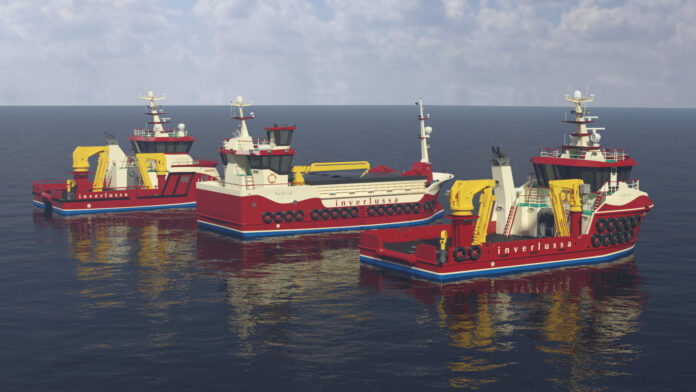
Inverlussa Marine Services has signed contracts for three new hybrid vessels in a fleet expansion programme that will increase its fleet to 25 vessels when the ships are delivered in summer 2027.
The Scottish aquaculture support company has ordered a 20-metre by 12-metre heavy service catamaran from Macduff Shipyards, a 25-metre by 10.6-metre heavy service vessel from Nauplius Workboats, and a 27-metre by 11-metre fish feed carrier with a 400-tonne hold capacity from Parkol Marine Engineering.
All three vessels have been designed by Macduff Ship Design and will be equipped with battery-hybrid propulsion systems and IMO Tier III engines aimed at reducing emissions and improving fuel efficiency.
The Macduff vessel follows the delivery of the Naomi Jennifer in 2025 and extends Inverlussa’s relationship with the Aberdeenshire shipyard. The vessel under construction at Nauplius will be the fifth developed by Inverlussa with the yard, while the feed carrier marks the company’s first project with Parkol.
Inverlussa said the investment is expected to create around 20 jobs.
Ben Wilson, managing director of Inverlussa Marine Services, said: “We will continue to invest in the latest vessels, technology and our crew to maintain our position as a market leader in Scotland.
“As a family-owned business with a long-term outlook, we can make decisions that prioritise our customers, crew and the long-term success of the business rather than focusing on short-term shareholder returns.
“We believe one of the strengths of Scottish aquaculture is its commitment to working with local marine companies such as Inverlussa, helping to support jobs, investment and the sector’s social licence in coastal communities.”
Tavish Scott, chief executive of Salmon Scotland, said the order reflected continued investment in Scotland’s aquaculture supply chain.
“This is a very welcome investment and another sign of confidence in the future of Scottish salmon farming.
“These new hybrid vessels show how innovation is helping to reduce emissions, improve efficiency, and support responsible growth.
“Scottish salmon already has a low carbon footprint, but farmers and their suppliers are constantly looking for ways to go further.
“This kind of investment supports jobs and skills in coastal communities, while strengthening the businesses that help make Scotland a world-leading producer of salmon.”