

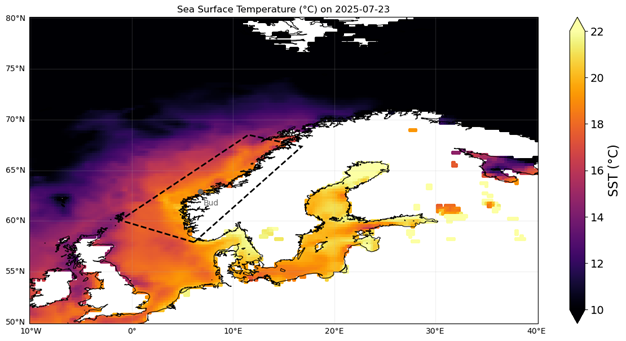
Marine heatwaves to become more frequent off UK and Irish coasts, study warns.
Marine heatwaves around the UK and Irish coasts are becoming increasingly likely, with scientists warning that events similar to the record-breaking temperatures of 2023 could occur once every 10 years, according to a report by The Guardian.
The study, published in Communications Earth & Environment and conducted by researchers from the University of Exeter, the Met Office and the Centre for Environment, Fisheries and Aquaculture Science (Cefas), found that the 2023 marine heatwave – described as “unheard of” – was consistent with long-term climate models.
During the 2023 event, shallow sea temperatures in areas including the North Sea and the Celtic Sea rose by as much as 2.9°C above the June average for a period of 16 days. The heatwave raised concerns about the survival of fish, shellfish and kelp populations.
The researchers calculated that in the Celtic Sea, the annual probability of a marine heatwave of that intensity has increased from 3.8 percent in 1993 to 13.8 percent today. In the central North Sea, the likelihood rose from 0.7 percent to 9.8 percent over the same period.
“Our findings show that marine heatwaves are a problem now – not just a risk from future climate change,” said lead author Dr Jamie Atkins, who conducted the study during his PhD at the University of Exeter and is now at Utrecht University.
Co-author Professor Adam Scaife, head of long-range forecasting at the Met Office, said the results illustrate “how steady climate warming is leading to an exponential increase in the occurrence of extreme events.”
The study also linked warmer seas to higher land temperatures and heavier rainfall during the 2023 summer. “Warmer seas provide a source of heat off the coast, contributing to higher temperatures on land,” Atkins said. “Additionally, warmer air carries more moisture – and when that cools it leads to increased rainfall.”
Professor Ana M. Queirós of the Plymouth Marine Laboratory told The Guardian that prolonged marine heatwaves disrupt ecological cycles such as reproduction and hatching, warning that “this is certainly a very bad sign for the health of our planet and our ocean, and one likely to worsen unless we make significant strides to cut emissions.”