

HI reports higher sea lice levels in north as production increases.
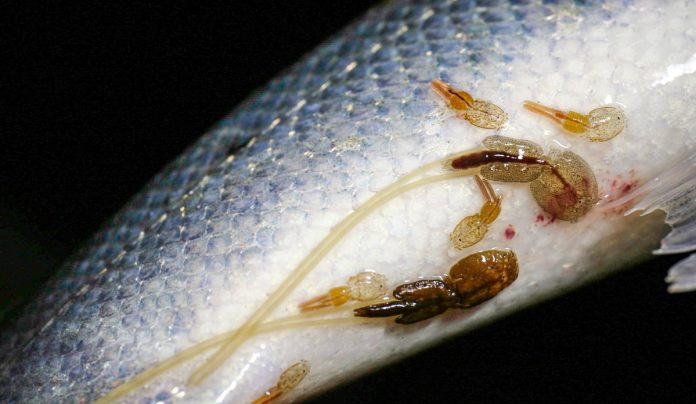
Norway’s Institute of Marine Research (HI) has reported increased levels of salmon lice in northern farming regions, linking the rise to higher production and warning of greater infection pressure on wild salmon.
Presenting its 2025 knowledge base for the government’s traffic light system, HI said this year’s national monitoring and modelling results broadly mirror those from 2024, but confirm a continued northward shift of lice pressure.
“We see that increased production in the northern areas has led to more lice in the farming facilities and thus higher infection pressure for wild salmon,” said Ørjan Karlsen, project leader for salmon lice at HI.
The institute has delivered three reports to the Ministry of Trade, Industry and Fisheries as its contribution to the traffic light scheme, which regulates aquaculture growth by assigning green, yellow or red status to 13 production areas based on environmental impact.
Hardanger fjord was identified as the most affected area for wild salmon smolt in 2025, with “a lot of lice” observed on out-migrating smolt in spring. In Boknafjorden and Sognefjorden, lice levels were assessed as moderate, and in Romsdalsfjorden and Altafjorden as low. HI noted, however, that low catches in Sognefjorden and Romsdalsfjorden increased uncertainty in this year’s observations there. The lice distribution patterns seen in the field monitoring were largely confirmed by the institute’s modelling work.
Karlsen said the use of lice dispersion models is essential to provide coverage along Norway’s long coastline, supplementing field data both in monitored areas and in regions without direct sampling.
Sea trout and Arctic char were again found to be heavily affected by lice in many regions. Unlike Atlantic salmon smolt, which migrate out of the fjords relatively quickly, sea trout and char remain in fjords and along the coast for long periods in summer, exposing them to prolonged infection pressure.
According to HI, monitoring indicates more than 30 percent mortality from salmon lice in sea trout at one or more stations in all production areas from Ryfylke (PO2) to Kvaløya (PO11). In the remaining areas (PO1, PO12 and PO13), mortality was estimated at less than 10 percent at all monitored stations.
For now, the traffic light assessments are made on the basis of lice effects on wild Atlantic salmon only. The increased risk for sea trout and Arctic char is not included in the formal classification but is documented in the reports.
HI also highlighted the role of sea temperature. Most coastal areas experienced relatively mild conditions through winter and spring, followed by a cooler early summer. From early July, temperatures rose, with a marine heatwave recorded on the north-west coast lasting around three weeks. Elevated summer temperatures, also seen in other regions in July and partly in August, occurred after wild salmon smolt had already migrated to sea, and therefore primarily affected sea trout feeding in fjords.
Salmon lice, a small crustacean parasite, develop faster at higher temperatures, and HI said the warm summer in 2025 contributed to increased lice development and was classified as a marine heatwave event.