Tasmania rules out salmon farming link to harmless plankton bloom.
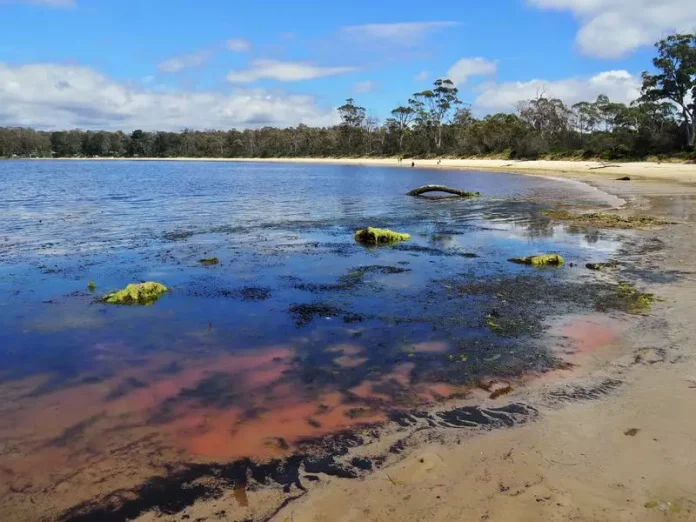
Tasmania’s environment department has said a pink-coloured substance observed along parts of the state’s southeast coastline is a naturally occurring plankton bloom and is not linked to salmon farming.
The material was found along a stretch of Randalls Bay, around 60 km south of Hobart, with similar sightings reported at other beaches in southeast Tasmania. Testing by the department identified the organism as Noctiluca scintillans, a marine plankton species that feeds on microscopic algae.
The department said Noctiluca scintillans is distinct from Karenia cristata, which has been responsible for harmful algal blooms in South Australia, and poses no known risk to human health or marine ecosystems in Tasmania.
“There is no known link between Tasmanian aquaculture and an increase of Noctiluca scintillans events,” the department said in a statement, adding that the species occurs naturally in Tasmanian waters and globally.
Concerns had been raised publicly by anti-salmon farming groups, who suggested the substance could be pollution-related and linked to nearby fish farms.
Industry body Salmon Tasmania, which represents the state’s major salmon producers, said the claims were unfounded. A spokesperson said the department’s findings showed there was no connection between the bloom and salmon farming activity.
Debate around aquaculture in Tasmania has intensified in recent years, particularly after a disease outbreak last summer led to the loss of thousands of tonnes of farmed salmon.
The environment department said blooms of Noctiluca scintillans are not unusual at this time of year and can produce visible “sea sparkle” bioluminescent displays at night. It added that monitoring for harmful algal blooms is ongoing and that no harmful species have been detected.
The department said testing was carried out to provide public reassurance and that no further action is required at this stage.