

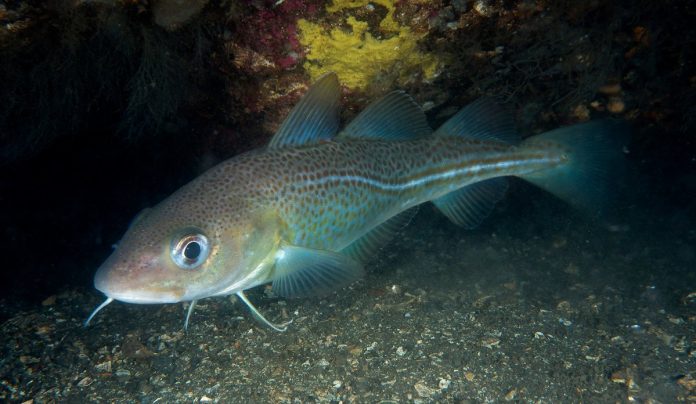
Havforskningsinstituttet assesses low to moderate risk from salmon farming to coastal cod stocks.
Norway’s Institute of Marine Research has published its first formal risk assessment of potential negative effects from open-net pen salmon farming on coastal cod (kysttorsk), concluding that risk at population level is low to moderate, with significant knowledge gaps remaining.
The findings are presented in the report Risk for negative effects on coastal cod stocks as a result of salmon farming in open sea cages – risk assessment and knowledge status 2026.
Researchers examined several potential interaction pathways, including consumption of spilled salmon feed by cod, attraction of cod to farming sites, and disease transmission.
The assessment finds that salmon feed differs nutritionally from cod’s natural diet, particularly in fatty acid composition. When cod consume salmon feed, their fatty acid profile changes. Researchers said it is currently unclear what biological consequences this may have, although reduced reproductive performance is identified as a potential worst-case outcome.
The report also highlights limited knowledge on whether coastal cod actively avoid salmon farms or whether attraction to farms could influence spawning behaviour in some fjords. In contrast, the Institute said current evidence indicates a low likelihood of disease transmission from farmed salmon to cod, as the most common salmon diseases are not known to infect cod.
Risk has been assessed separately for areas south and north of 67°N latitude. For southern coastal cod stocks, which are generally in poorer condition, the Institute concludes a moderate risk of negative impact from salmon farming, subject to high uncertainty. For northern stocks, where spawning biomass is estimated at around 85,000 tonnes and overall condition is stronger, the risk is assessed as low.
Researchers noted that while most cod appear to prefer natural prey, a proportion of the population is attracted to salmon farms. The scale of this interaction, and its long-term consequences, remain uncertain.
The Institute said further work will focus on quantifying how much of the coastal cod population aggregates around farms and whether long-term feeding on salmon pellets affects reproduction and recruitment.
The report is part of a broader series of environmental risk assessments linked to Norway’s aquaculture management framework.