

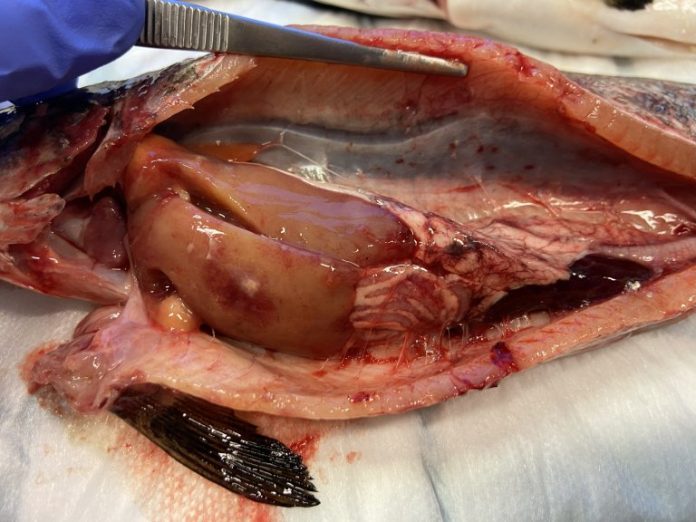
Chile’s fisheries authority, Sernapesca, has published an updated health program for Piscirickettsiosis control (Res. Ex. 980/2026), introducing mandatory vaccination and new prevention measures for salmon farming sites.
SRS (Salmon Rickettsial Syndrome), caused by Piscirickettsia salmonis, is the leading disease burden on Chile’s salmon industry and the primary driver of antibiotic use in the sector.
The program requires mandatory vaccination across farming sites. It also introduces a voluntary preventive management plan and allows a one-time pen split per production cycle to reduce fish contact density in cages.
Fish losses linked to health management procedures defined under the program will be excluded from mortality counts, provided animal welfare standards are maintained, Sernapesca said.
The Pontificia Universidad Católica de Valparaíso’s Aquatic Pathogens Laboratory has been designated as the reference laboratory for Piscirickettsiosis. It will identify P. salmonis genotypes circulating at farming sites to improve field-level data and support operational decision-making.
The program’s genotype monitoring component marks a step toward more targeted disease management. Whether mandatory vaccination translates into reduced antibiotic volumes will be a key metric to track as the program takes effect.