

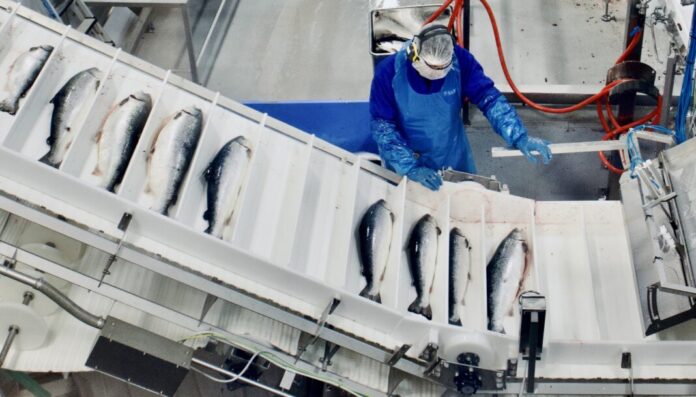
Salmon price drops sharply as supply surges.
Norwegian salmon prices fell sharply this week as increased harvest volumes weighed on the market.
Prices are estimated at around EUR 6.37 per kilogram (USD 7.51), down from approximately EUR 7.67 (USD 9.03) the previous week, based on a roughly NOK 85/kg level. The decline amounts to close to 18% week on week, according to analysts.
Pricing typically softens ahead of the Seafood Expo Global in Barcelona, suggesting limited scope for a near-term recovery.
The correction follows a marked increase in supply. Norwegian harvest volumes have risen toward a 31,000-tonne weekly run rate this week, up 17% week on week, based on AIS tracking models.
The increase has been linked to favourable sea temperatures in central and northern Norway, where roughly 75% of the country’s biomass was located at the end of February.
Export volumes reached 26,555 tonnes last week, down 14.5% year on year but up 15.4% week on week.
Demand for Norwegian salmon stood at EUR 186 million (USD 219 million) last week, down 3.1% year on year but up 7.5% week on week. The figures remain somewhat distorted by the timing of Easter, analysts noted. The comparable post-Easter week last year recorded EUR 187 million, indicating a broadly similar underlying level.
Operational performance in Norway remains stable and is not expected to change materially in the near term, placing pressure on forward price expectations.
Average prices in the second quarter of 2025 were around EUR 6.55 per kilogram (USD 7.72), while consensus estimates for the second quarter of 2026 had been closer to EUR 7.63 (USD 8.99). Current market developments suggest those forecasts may need to be revised downward, analysts said.
In Chile, Sernapesca held a coordination meeting last week to address a harmful algal bloom affecting 11 farming sites.
No significant mortality losses have been recorded so far. However, the risk remains given historical precedent, with a super El Niño-related algal bloom in 2016 reducing Chilean salmon supply by around 16% year on year, analysts noted.