

Norway’s government has approved production growth in three salmon farming regions while ordering a capacity reduction in one area under the country’s traffic light system for aquaculture.
The decision, announced by Fisheries and Oceans Minister Marianne Sivertsen Næss on Friday, could result in approximately 8,300 tonnes of additional maximum allowed biomass (MTB) being allocated in green-rated production areas. At the same time, production capacity in one red-rated area will be reduced by an estimated 5,300 tonnes.
The traffic light system determines whether salmon farming capacity can increase, remain unchanged or be reduced based on the impact of sea lice on wild salmon populations.
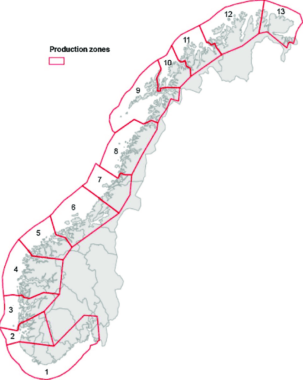
Three production areas received green status, allowing operators to apply for up to 6% additional capacity: PO1 (Swedish border to Jæren), PO12 (West Finnmark) and PO13 (East Finnmark).
Nine production areas were classified as yellow, meaning capacity will remain unchanged. One area, PO3 (Karmøy to Sotra), received a red classification and will see production capacity reduced by 6%.
According to the ministry, this is the third time capacity has been cut in PO3 under the traffic light regime.
“We continue to facilitate growth in areas where the impact of sea lice on wild salmon is acceptable,” Sivertsen Næss said in a statement.
The colour classifications are based on scientific assessments of sea lice impacts during 2024 and 2025.
More areas turn amber
The minister expressed concern that more areas received yellow status than in previous assessments despite industry efforts to reduce environmental impacts.
“It concerns me that more areas than before are receiving yellow status, and that this is happening despite the objective of reducing impacts on wild salmon,” she said.
One area, PO9 (Vestfjorden and Vesterålen), received special consideration after scientific assessments differed between the two years under review. While expert evaluations suggested the area was moderately affected in 2024 and somewhere between low and moderate impact in 2025, the government’s final assessment concluded that environmental conditions remained consistent with a yellow classification.
The ministry cited elevated sea temperatures, indications of moderate mortality among wild salmon smolts, and concerns regarding sea trout populations as factors supporting the decision.
The government has also launched a consultation on the 2026 capacity adjustment regulations, with a deadline of 31 July.
Under the proposed allocation framework, 1% of new capacity in green areas will be offered at a fixed price to existing licence holders, with the remainder distributed through an auction process.
The traffic light system is reviewed every two years and remains the central mechanism governing growth in Norway’s salmon farming industry.