

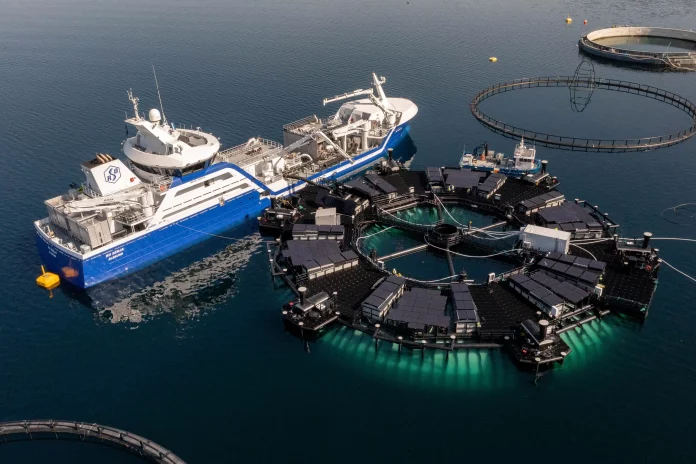
SalMar reports progress in Marine Donut development project.
SalMar and technology partner BlueGreen say the second production cycle of their Marine Donut development project delivered stable water quality, low mortality and biological performance broadly in line with expectations.
The findings are set out in a final report from production cycle two, which ran from 4 May to 6 July 2025 and forms part of a monitoring programme required by Norway’s Directorate of Fisheries under development licence conditions.
Water quality and environmental parameters were monitored continuously, including oxygen, temperature, salinity, pH, turbidity, CO₂ and algae levels. Average oxygen saturation was 91.5 per cent, and periods of high feeding did not result in negative oxygen effects, the report said. Mixing of fresh water into the fish volume functioned as intended.
A single intake of 185,196 salmon with an average weight of 3,002 grams was completed without deviations or fish welfare issues, SalMar said.
As in the first production cycle, water flow along the bottom of the fish volume was not sufficient to guarantee full transport of dead fish to collection traps. Lowering current generators has improved conditions, and no stationary dead fish were observed on the bottom during the second cycle. Accumulation of dead fish on outlet grates remains a challenge, with ROVs used to secure satisfactory removal. Further technical measures are planned ahead of the next stocking.
Feeding distribution in Marine Donut was assessed as good, while camera-based feed monitoring becomes demanding at high stocking densities. Feed intake can be observed, but defining a clear stop signal is difficult, affecting feed control and reflected in biological results, according to the report.
Fish health and welfare were followed through regular health visits, welfare scoring and gill examinations. Overall health status was considered generally good, with normal behaviour, good appetite and low to moderate mortality. Gill findings were mainly sparse to moderate and non-specific, with no indications of known diseases. Stress measurements showed expected short-term responses during fish transfers, followed by rapid normalisation.
Total production in cycle two was 236,207 kg, with an average weight gain of 1.27 kg and an economic feed conversion ratio of 1.20. Growth was in line with SalMar’s models despite periods of reduced feeding due to technical conditions.
Mortality while fish were held in Marine Donut was around 1.7 per cent. At harvest, 183,018 fish were slaughtered with an average weight of 4,285 grams, and a superior share of 90.9 per cent. Downgrading was mainly attributed to biological factors rather than production in Marine Donut.
Data and communication systems functioned as planned, with measurements stored in line with regulatory requirements. Full-scale measurements of water flow in the fish volume have been completed, while measurements of hydrodynamic pressure, global movements and mooring forces have been finalised and published in separate reports.
SalMar said experience from the first and second production cycles provides a factual basis for further optimisation of the Marine Donut concept, with identified changes and improvement measures to be incorporated into continued development.