

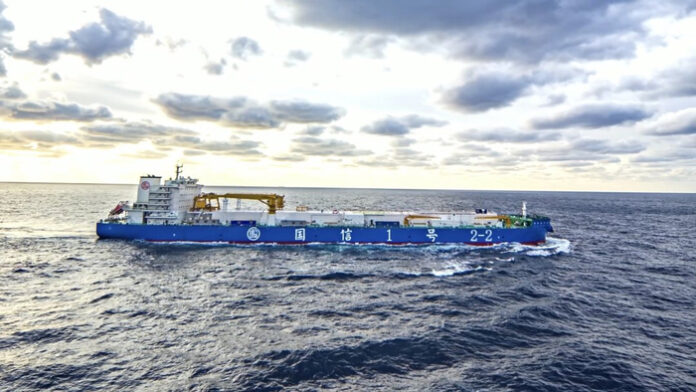
Qingdao Guoxin Group has harvested the first Atlantic salmon produced aboard its 150,000-tonne aquaculture vessel Guoxin No. 1 2-2, marking what the company described as the world’s first commercial-scale salmon harvest from an ultra-large mobile aquaculture ship.
The first harvest, consisting of 3,000 fish weighing 12 tonnes, was released onto the Chinese market on May 11, according to Chinese state media outlet the Economic Daily.
The salmon were produced using the vessel’s “ship-based tank farming” system, which allows the vessel to move along China’s coastline in search of optimal water temperatures.
Guoxin No. 1 2-2 was delivered in November 2025 and is the first vessel in the world designed to carry out year-round farming trials of Atlantic salmon and trout species aboard a large mobile aquaculture platform.
The first Atlantic salmon and rainbow trout smolt were stocked into the vessel in November last year using a combined land-sea production model in waters off Shandong province. After nearly six months of grow-out, the fish have now reached harvest size.
Atlantic salmon require relatively stable temperatures between 10C and 16C for optimal growth. China has historically relied heavily on imports of high-quality salmon products.
According to the company, the vessel’s “voyaging” farming model allows it to avoid typhoons, harmful algal blooms and other environmental risks while moving north and south seasonally to maintain suitable growing conditions.
The vessel contains 15 standard farming tanks with a total farming volume of close to 100,000 cubic metres. Individual tanks hold more than 6,000 cubic metres of water each.
The system uses deep-water intake technology to draw seawater from depths of 30 to 50 metres, with water exchanged 16 to 18 times per day.
Guoxin said the approach reduces exposure to nearshore pollution, parasites and disease risks.
The company stated the fish tested free of parasites, antibiotics and drug residues, and met China’s national standards for raw consumption seafood products.
The launch represents another step in China’s push to develop domestic salmon production capacity through offshore and land-based technologies as the country seeks to reduce dependence on imported fish.
Chinese authorities and state-backed companies have increasingly promoted the concept of a “blue granary”, referring to large-scale offshore food production systems intended to strengthen domestic seafood supply chains.