




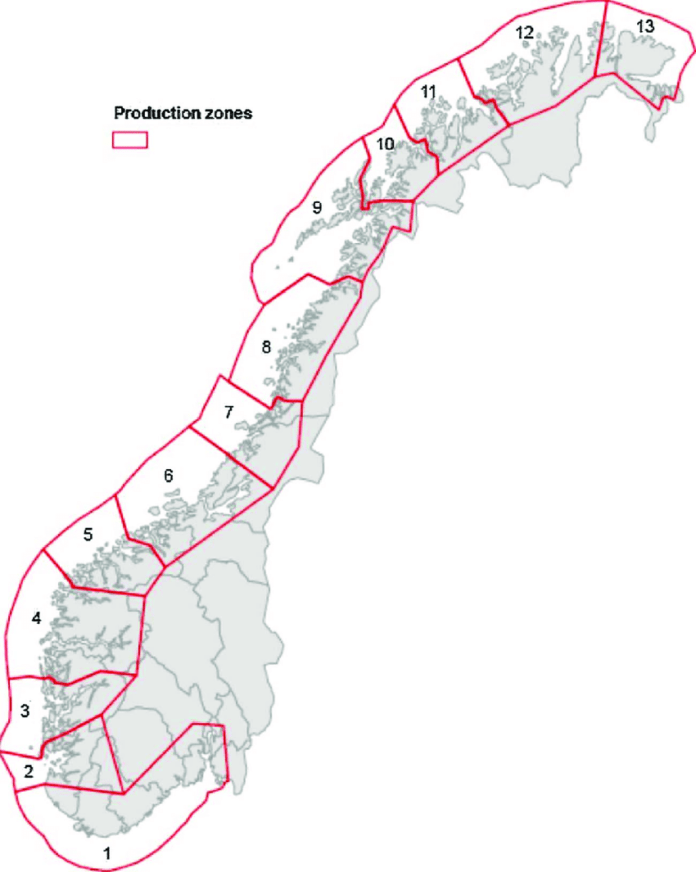
Norway’s Institute of Marine Research (HI) has proposed replacing the country’s current 13 salmon farming production areas with 28 smaller regulatory zones, arguing that a finer geographical division would improve the management of sea lice emissions.
The proposal follows last year’s Aquaculture White Paper, which outlined plans for a new regulatory framework focused on limiting the impact of sea lice from fish farms on wild salmon populations.
HI researcher Pål Næverlid Sævik said new modelling of sea lice dispersal showed that smaller management areas could make it easier to regulate emissions and reduce infection pressure on wild fish.
The proposal, developed jointly by researchers from the Institute of Marine Research and the Norwegian Institute for Nature Research (NINA), would divide each of the existing production areas into between one and four smaller zones, creating a total of 28 regulatory areas.
According to the researchers, the current production areas are large enough that shifting production within a single area can significantly alter sea lice pressure on wild salmon, while a more targeted system would better reflect how lice spread between farming sites.
The researchers said the proposed zones would remain large enough for most sea lice transmission to occur within, rather than between, individual regulatory areas.
The report has been submitted as input to the Norwegian government’s work on developing a new sea lice management system.
