

Stirling research identifies early-stage salmon lice proteins as potential control targets.
New research from the University of Stirling has identified significant differences in the secretions produced by salmon lice at larval and adult stages, offering potential new avenues for parasite control in aquaculture.
The study, led by PhD researcher Alexander Dindial at the Institute of Aquaculture, compared proteins released by infectious larval-stage lice, known as copepodids, with those produced by adult parasites. The work was carried out in collaboration with the Moredun Research Institute and funded by EastBio.
Researchers identified 143 secretory proteins present in copepodids that were absent in adult lice. These included proteins such as serpins, which are known from other parasitic species to play a role in suppressing host immune responses.
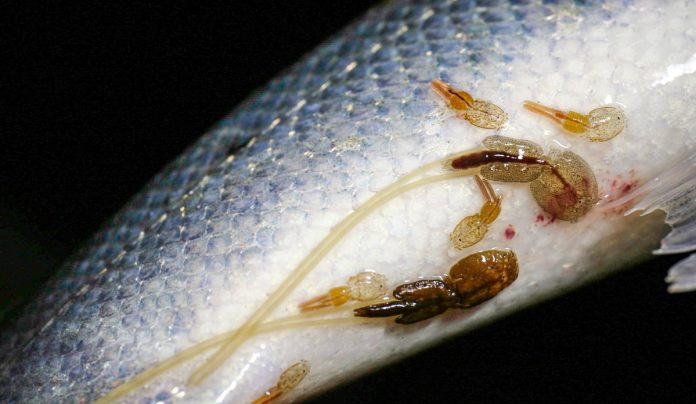
Salmon lice remain one of the most significant biological challenges in salmon farming, with global costs to the industry estimated at more than £1 billion annually. The parasites feed on the skin, mucus and blood of host fish, causing lesions that can lead to secondary infections, reduced growth, and lower market value.
Existing treatments, including chemical and mechanical approaches, have faced increasing scrutiny due to cost, variable efficacy, environmental concerns, and animal welfare implications.
The researchers said the newly identified proteins could help explain how lice successfully establish infections at an early stage, and may provide targets for future vaccine development.
“Because this is the very first stage of this parasite’s life cycle, it represents a vital linchpin in control strategies for this species,” said Dindial. “This work better helps us understand salmon louse biology and could play a vital role in informing future research into control of this parasite.”
The study involved incubating larval lice in filtered seawater, as well as in a solution containing isophorone, a compound found in Atlantic salmon mucus that acts as an attractant for copepodids. Secreted proteins were then isolated and analysed using liquid chromatography tandem mass spectrometry to determine their molecular composition.
Dr Sean Monaghan, co-supervisor of the study, said the findings could feed into ongoing research efforts. “This data provides key candidates for vaccines in the future. We are currently exploring the genes of these secreted proteins as part of a large BBSRC-funded project, GeNoLice, to determine if they are influenced by interactions with the host.”
The research, titled Investigation of proteins identified in the secretory and excretory products (SEPs) of the infectious copepodid stage of Lepeophtheirus salmonis, has been published in the journal Veterinary Parasitology.