

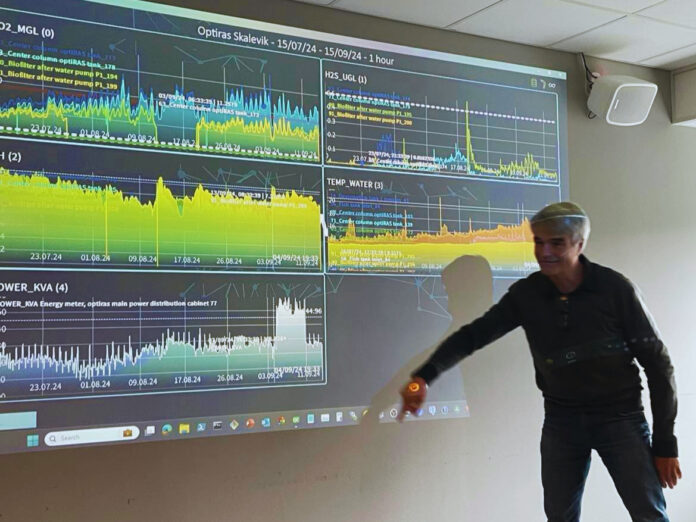
Norwegian technology company Searas has been awarded funding from the Norwegian Seafood Research Fund to develop and pilot a real-time monitoring system aimed at reducing mortality risk in recirculating aquaculture systems.
The project, valued at NOK 2.5 million, will focus on developing a synthetic sensor to measure total inorganic carbon (TIC), a parameter the company says represents a largely unmonitored risk in closed facilities.
High levels of TIC can lead to the release of large volumes of CO₂ if pH drops, creating acute stress conditions and, in some cases, fish mortality. The risk is considered highest toward the end of production cycles and during crowding events.
“Experience from RAS facilities shows that traditional measurements of CO₂, O₂ and pH are not enough. The water has an inherent risk linked to TIC,” said Eldar Lien, project manager at Searas. “We are now developing not only a tool to measure this risk, but a framework to actively manage it.”
The project will combine real-time monitoring with operational tools, including thresholds and response protocols, intended to give operators earlier warning of deteriorating water quality and allow intervention before conditions become critical.
Searas said TIC offers a more complete picture of water chemistry than CO₂ alone, as it captures carbon stored in multiple forms that can be released rapidly under changing conditions. The same mechanism can also increase the risk of hydrogen sulfide formation.
“What the operator needs is not just to see a number, but to see trends and understand what is building up in the water over time,” Lien said.
The project is being carried out in partnership with Baring Farsund, which will provide operational data and testing capacity, and Mowi, which will contribute data from a freshwater RAS facility.
“For us, this is about operational reliability. If we can see TIC building up early, we have a better basis for managing degassing and preventing stress and unwanted incidents, especially when the load is high,” said Bjarte Sævareid, production manager at Baring Farsund.
The pilot will be conducted in both seawater and freshwater systems, with the aim of developing a practical decision-support tool for farm operators. The project runs from February 2026 to January 2027.