

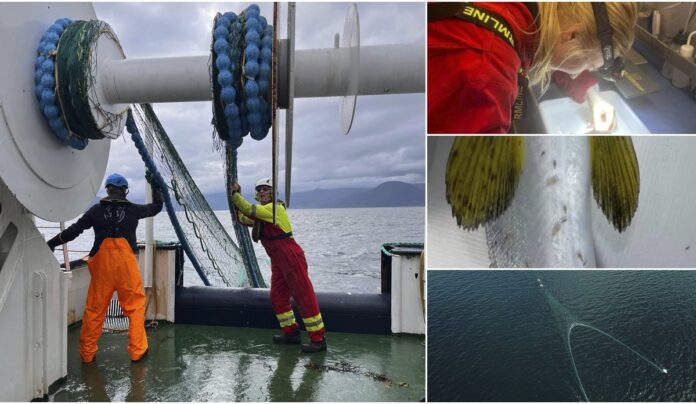
DNA analysis of more than 1,200 lice collected from wild Atlantic salmon post-smolts in six Norwegian fjords showed that salmon lice, not Scottish sea lice, overwhelmingly dominated infestations during the fish’s migration to sea.
The findings, published by Norway’s Institute of Marine Research, address a long-running question over whether Scottish sea lice, known in Norwegian as skottelus, could be a major source of lice pressure on wild salmon.
Unlike salmon lice (Lepeophtheirus salmonis), which are highly specialised parasites that primarily infect salmonids, Scottish sea lice (Caligus elongatus) are generalist parasites found on a wide range of marine fish species. Scottish sea lice are frequently present in salmon farming areas and can appear in significant numbers on adult fish, particularly in northern Norway, leading some researchers to question whether they may be contributing more heavily to lice infestations on migrating wild salmon than previously thought.
Researchers analysed 1,381 attached lice collected from 325 wild salmon post-smolts caught by trawl in Trondheimsfjorden, Romsdalsfjorden, Nordfjorden, Sognefjorden, Hardangerfjorden and Boknafjorden between late April and early June.
Of the 1,243 lice successfully identified through DNA testing, 98% were salmon lice, while just 2% were Scottish sea lice.
“Salmon lice are clearly the dominant louse species on post-smolts of wild salmon migrating through the fjords,” said IMR scientist John Fredrik Strøm.
The study focused on attached lice, an early stage in the parasite lifecycle before the lice become mobile. Researchers said these juvenile stages are difficult to distinguish visually, making DNA analysis necessary.
“When salmon migrate out through the fjords, there is a large predominance of attached lice on the fish. Researchers have long assumed these were caused by salmon lice, but because Scottish sea lice can occur in significant numbers among larger and mobile lice stages, questions have been raised,” Strøm said.
Researchers carried out genetic analysis on more than 1,200 attached lice collected from wild salmon post-smolts during their migration period.
The results showed salmon lice dominated across all sampled fjords and throughout the migration period, regardless of when the fish were caught.
“The only times Scottish sea lice appeared in a significant proportion was when there were generally few lice on the fish,” Strøm said.
The researchers concluded that the same louse species creating the greatest challenges in salmon farming is also responsible for the majority of lice pressure on wild salmon migrating through central and western Norwegian fjords.
The study did not include northern Norwegian fjord systems, where Scottish sea lice prevalence may be higher due to infection pressure from wild marine fish species.
“In northern Norway there can be large amounts of Scottish sea lice in salmon cages. These outbreaks are often caused by infection from wild marine fish, and it is possible that the ratio between salmon lice and Scottish sea lice may differ somewhat there,” Strøm said.
The research was published in Aquaculture Environment Interactions under the title Salmon louse Lepeophtheirus salmonis predominates over Caligus elongatus on Atlantic salmon post-smolts in central and western Norway.