





Canadian Aquaculture Industry Alliance flags rising salmon imports amid falling BC production.
Canada’s reliance on imported farmed salmon has increased sharply over the past decade as domestic production in British Columbia has declined, according to a new report from the Canadian Aquaculture Industry Alliance.
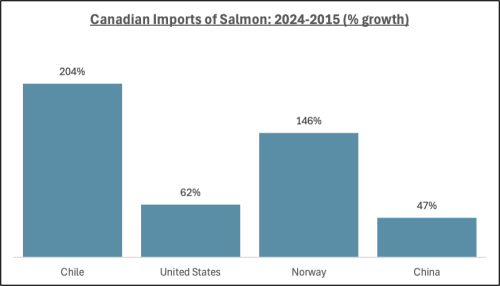
The report shows that farm-raised salmon production in British Columbia has fallen by more than 40% since 2015. Over the same period, the value of Canada’s salmon imports has more than doubled, reaching around CAD 700 million annually, with increased volumes sourced from countries including Chile and Norway.
The industry group said the divergence reflects strong underlying demand for salmon, which remains the most consumed seafood species in Canada, alongside policy and regulatory constraints that have limited production growth in BC, historically the country’s largest salmon farming region.

BC Salmon Farmers Association executive director Brian Kingzett said the data indicated demand could be met domestically if regulatory certainty improved. He argued that current policies were restricting Canadians’ ability to purchase locally produced salmon despite continued consumer demand.
According to the association, farmed salmon production in BC currently supports more than 4,000 jobs and generates approximately CAD 1.2 billion in annual economic output, with economic activity concentrated on Vancouver Island and in the Lower Mainland. The sector estimates that, with improved investment conditions, output could rise to CAD 2.5 billion and employment to around 9,000 jobs by 2030, increasing further by 2040.
The report also links rising imports to broader food security and climate considerations, noting that imported salmon typically travels longer distances by sea or air than domestically produced fish, increasing transport-related emissions.
The findings draw on production data from Statistics Canada and import data from federal trade databases. The BC Salmon Farmers Association represents around 60 businesses and organisations across the province’s finfish aquaculture value chain, accounting for more than 95% of BC’s farmed salmon harvest.
