




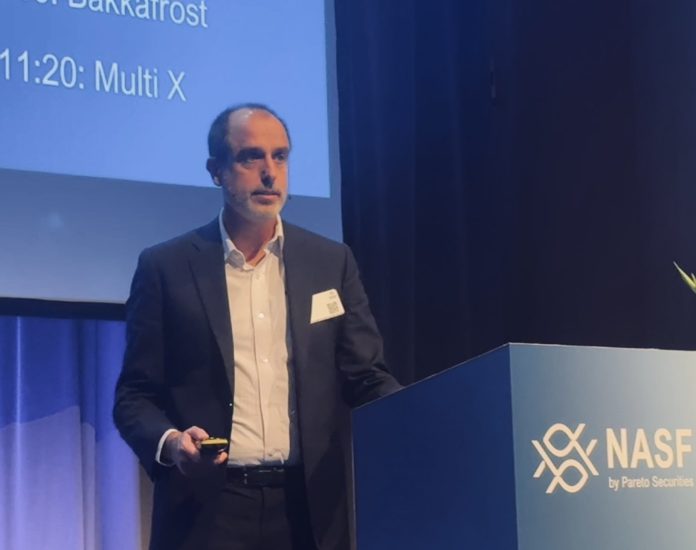
Multi X executive says Chile poised to restart salmon growth.
Chile’s salmon farming sector could return to a growth phase after nearly two decades of regulatory and political disruption, according to Multi X executive Cristián Swett.
Speaking at the North Atlantic Seafood Forum (NASF) in Bergen last week, Swett said Chile was widely expected to overtake Norway as the world’s leading salmon producer in the mid-2000s. At the time, Chilean production was doubling roughly every two years and Norway’s output was only around 10 percent higher.
However, the trajectory changed after the infectious salmon anemia (ISA) crisis in 2007, which resulted in major fish losses and triggered sweeping regulatory reforms across the industry.
“In 2006 Norway was producing only about 10 percent more than Chile,” Swett said. “Today it produces roughly 50 percent more, and if you look only at Atlantic salmon the gap is closer to double.”
He said Chile has only recently doubled the production levels it had in 2006, with most recent growth coming from coho salmon rather than Atlantic salmon.
Swett said the sector has faced a series of additional pressures over the past decade, including harmful algal blooms in 2016, growing criticism from environmental NGOs, and political opposition to aquaculture.
Regulatory changes linked to indigenous coastal rights, particularly under the Lafkenche Law, have also complicated access to farming areas, while broader political instability during the 2019 social unrest and the debate over a new constitution created further uncertainty for investors.
The proposed constitution, rejected by voters in 2022, contained provisions that Swett said could have made long-term salmon farming in Chile difficult.
He also noted that around 41 percent of Chile’s marine areas are now protected, rising to roughly 60 percent in regions where salmon is currently produced.
As a result, very few new aquaculture concessions have been granted since 2017.
Despite these challenges, Swett said political and public sentiment towards the industry has begun to shift. A controversial regulatory proposal in 2023 that would have further restricted industry growth prompted protests involving around 10,000 workers.
More recently, he said public debate around the funding and influence of environmental NGOs has altered the tone of the discussion, while political leadership has become more supportive of the sector.
According to Swett, the next Chilean administration is expected to pursue regulatory reforms aimed at providing greater certainty for producers and reducing operational costs.
“With social and political support returning, we believe Chile can restart growth,” he said.
