




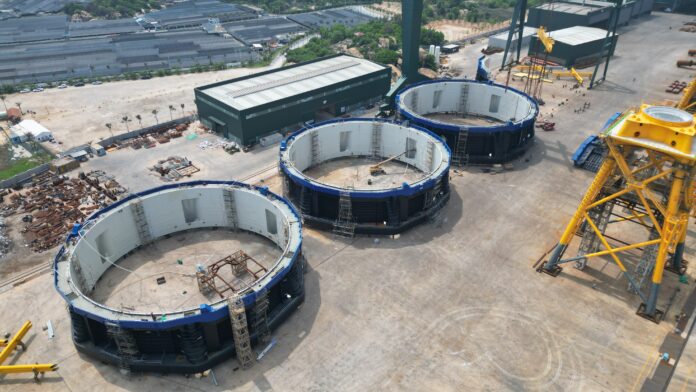
Norwegian aquaculture technology company Seafarming Systems has selected nanobubble oxygenation technology from Moleaer for six closed Aquatraz cages currently under construction and scheduled for completion by the end of 2026.
The Aquatraz closed-cage system has been developed as a controlled production solution aimed at improving fish welfare, biosecurity, and environmental performance in salmon farming. Each cage has a volume of 70,000 cubic metres and is designed for three water exchanges per hour.
According to Seafarming Systems, the closed production concept is intended to provide greater control over sea lice, emissions, and other biological conditions while maintaining operational efficiency.
The company said it selected Moleaer’s submersible Freya nanobubble generators following an evaluation of several oxygenation technologies conducted together with customers.
“The choice of Moleaer was made in close collaboration with our customers, where several different oxygenation technologies were evaluated, and based on existing experience, Moleaer came out on top,” said Lasse Hiller of Seafarming Systems.
“Their technology has demonstrated a very high oxygen transfer rate, while the company also possesses significant expertise and experience from demanding aquaculture projects. Their solution is easy to scale within Aquatraz, which gives our customers confidence that the system can be tailored over time to suit different locations and densities,” he added.
Moleaer supplies nanobubble systems used in aquaculture, wastewater treatment, irrigation, and water restoration applications. The technology is designed to improve oxygen transfer efficiency and water quality through the generation of stable nanobubbles.
“Seafarming Systems represents some of the most innovative work we see in modern aquaculture,” said Inge Haarberg of Moleaer.
“The Aquatraz concept combines solid engineering expertise with a clear sustainability vision, and we are proud to contribute technology that enables more controlled and sustainable closed production at sea,” he said.
