




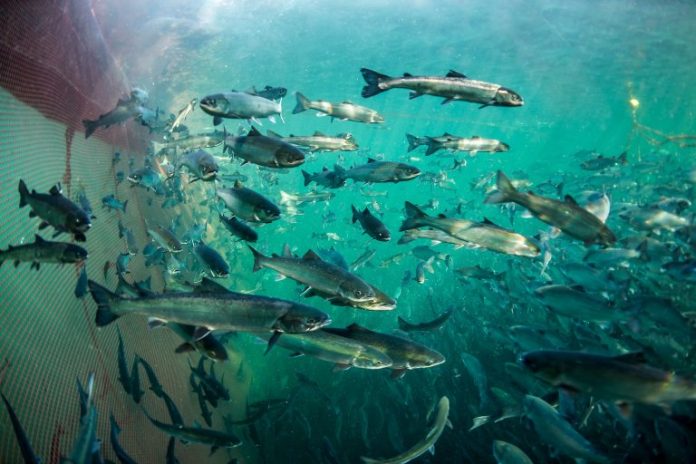
Warmer seas drive record lice treatments, but salmon quality rises.
Rising sea temperatures are creating new health and welfare challenges for farmed salmon in Norway, according to the latest fish health report from the Norwegian Veterinary Institute.
The annual Fish Health Report for 2025 shows that warmer waters contributed to a record number of sea lice treatments across the industry. Despite this, mortality among farmed salmon did not increase compared with previous years, suggesting overall fish health may have improved.
Periods of higher sea temperatures allow parasites and microorganisms to multiply more rapidly and spread to new areas, said Ingunn Sommerset. Diseases previously concentrated in southern regions are now appearing further north, indicating climate change may be altering production conditions along the Norwegian coast.
Record number of lice treatments
Sea lice remained the largest parasite challenge for the industry. In 2025 the sector recorded 3,918 treatment weeks, around 700 more than the previous year, with a record level of non-medicinal delousing operations.
In a survey of fish health personnel, 81% reported an increased need for lice treatments in their regions. Handling-related injuries linked to delousing operations were ranked as the leading cause of mortality and reduced welfare in harvest-size salmon.
Increase in AGD and IPN cases
The report also recorded a rise in several infectious diseases. A total of 99 cases of amoebic gill disease (AGD) were detected in 2025, a marked increase from previous years. The parasite responsible for AGD thrives in warmer waters and was detected as far north as Troms during the year.
Cases of infectious pancreatic necrosis (IPN) also rose sharply, with 40 detections recorded in 2025, roughly three times the level seen the previous year.
Mortality declines slightly
Overall mortality in the seawater phase fell modestly. Around 54.9 million farmed salmon were reported dead in sea cages during 2025, down from 57.8 million in 2024 and 62.8 million in 2023. This corresponds to an estimated annual mortality risk of 14.2%, compared with 15.4% in 2024 and 16.7% in 2023.
In the freshwater phase, 43.3 million salmon smolt weighing more than three grams were reported dead in 2025, down from 46.3 million the previous year.
Data from the industry’s AquaCloud platform indicate that injuries accounted for around 33.5% of recorded mortality causes, followed by infectious diseases at 28% and unknown causes at roughly 27%.
Notifiable diseases
Infectious salmon anaemia (ISA) was confirmed at 18 locations during 2025. Pancreas disease (PD) was detected in 44 cases, down from 48 the previous year.
At the same time, slaughter quality improved. The share of superior-grade salmon increased to 86.9% in 2025, up from 80.6% the year before, reflecting fewer fish downgraded due to wounds or injuries.
The report draws on public statistics, laboratory diagnostics, industry surveys and mortality data collected through AquaCloud.
