




Salmon executives question viability of Norway’s aquaculture white paper.
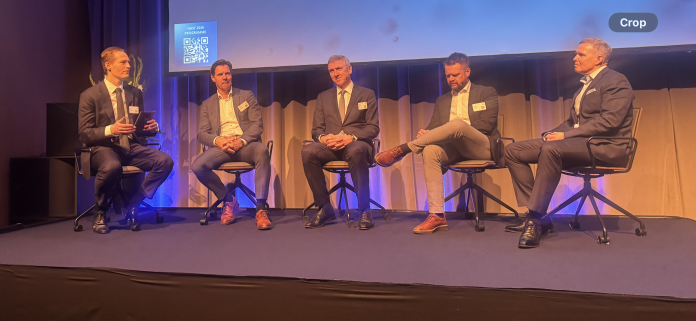
Senior executives from four of the world’s largest salmon farming companies raised concerns over Norway’s proposed aquaculture white paper during a panel discussion at the North Atlantic Seafood Forum in Bergen on Wednesday, warning that the policy framework may hinder industry growth.
The debate came as Norway’s government seeks to reshape aquaculture regulation. A cross-party majority in Parliament last year backed a new policy direction that retains the existing biomass limits and traffic light system while introducing incentives aimed at improving environmental performance.
However, industry leaders suggested the proposed framework risks restricting production and fails to address the operational realities of salmon farming.
Growth questioned
Speaking during the salmon industry panel moderated by Pareto Securities analyst Henrik Knutsen, Mowi CEO Ivan Vindheim questioned whether the white paper could deliver the “sustainable growth” policymakers have promised.
“The key word is so called sustainable growth. And that is in the eye of the beholder,” he said. “I am not convinced that the white paper will give the basis for organic growth going forward.”
Vindheim argued that, taken at face value, the policy could reduce national production.
“If you take the white paper at its word it advocates for taking production down by a quarter,” he said. “So I find it very interesting that we are talking about growth, because I think it will be quite a struggle to continue to do what we do in this country.”
He also criticised the regulatory emphasis on sea lice, arguing that the decline in wild salmon populations cannot be attributed solely to aquaculture.
“The idea that lice is the primary cause of decline of the wild salmon doesn’t make sense because we see the same decline everywhere,” he said.
Vindheim suggested a more site-specific regulatory model, focusing on factors such as mortality and environmental footprint rather than broad regional measures.
Incentives for technology
Henning Beltestad, CEO of Lerøy Seafood Group, said the industry must improve its communication with policymakers and the public.
“The best thing we can do is get close to the politicians to get them on the same level as we do,” he said. “We need to be better at communication because there is a lot of misunderstanding out there.”
Beltestad also called for stronger incentives to support technological solutions aimed at reducing sea lice.
“We have to have incentives for using new technology to reduce the sea lice,” he said. “The mortality is going down, the quality of the fish is going up but we are doing it without the incentives.”
Broader regulatory approach
Runar Sivertsen, chief operating officer at SalMar, warned that regulatory discussions remain too narrowly focused on sea lice.
“Sea lice is a big issue but I think the regulatory side has too narrow a focus on the sea lice,” he said. “We should focus on the salmon and fish welfare and sea lice will follow.”
Sivertsen also rejected the idea of introducing sea lice quotas.
“It’s a big no on sea lice quotas from me,” he said, arguing instead for broader industry ambitions and a more holistic regulatory framework.
Permitting bottlenecks
Steven Rafferty, CEO of Cermaq, pointed to structural issues in Norway’s licensing system that he said are slowing industry development.
“The governing structure of the industry is not fit for purpose. Things take too long,” he said.
Rafferty noted that Cermaq sees potential to expand production in northern Norway but faces lengthy approval processes.
“Our company operates up north and there is plenty of space in Finnmark to grow but to get a new site is a conflict between the local and central government,” he said. “It takes years and years of effort but it should be possible to do in a six month period.”
He also questioned whether national targets such as a five percent mortality rate are achievable without greater industry consultation.
“There is an aspiration for a five percent mortality target but it’s totally unachievable,” Rafferty said. “They need to get round the table and discuss with us what is possible.”
