




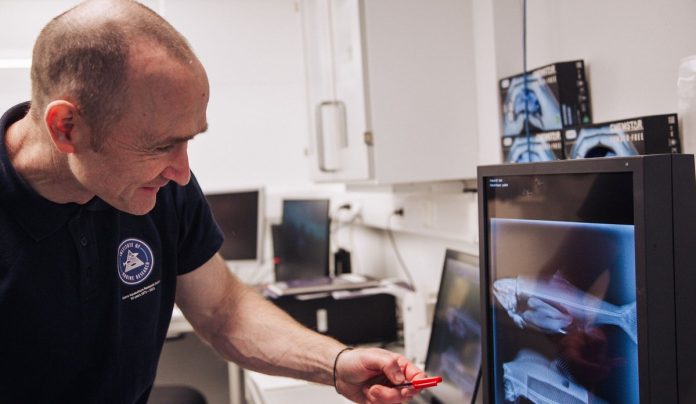
High prevalence of deformities found in farmed rainbow trout.
A high proportion of farmed rainbow trout develop skeletal deformities as they grow, with implications for fish welfare, growth and product quality, according to new research from the Norwegian Institute of Marine Research.
In a controlled trial following a single cohort of rainbow trout from an average weight of 36 grams to a harvest size of 5.5 kg, more than 90 percent of the fish had developed deformities in the spine by the end of the production cycle, researcher Per Gunnar Fjelldal said. The level observed is significantly higher than what is typically reported in farmed Atlantic salmon.
“Skeletal deformities cause welfare problems in farmed fish and also reduce growth and quality. It is therefore important to understand how these deformities develop throughout the entire production cycle,” Fjelldal said.
The 13-month study involved repeated X-ray examinations of 80–100 fish at four stages of growth. The fish were initially reared in freshwater tanks until they reached 160 grams, before being transferred to sea cages, where they remained until harvest. Growth rates were described as comparable to those seen in commercial production.

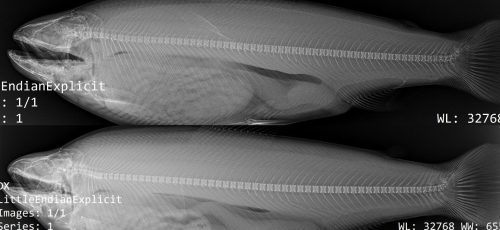
Photo: Per Gunnar Fjelldal, Institute of Marine Research
Researchers found few deformities at early life stages, but the prevalence increased steadily as the fish grew. During the sea phase, deformities developed in multiple parts of the spine, including the neck region, abdominal cavity, tail and tail-fin area. Around 65 percent of the fish showed deformities in the vertebrae associated with the tail fin, alongside degeneration and reduced size of the fin itself, affecting swimming ability.
To assess whether the findings were relevant for commercial farming, the researchers also examined three groups of rainbow trout from a single commercial site. Similar deformities were identified, although Fjelldal stressed that this does not mean all rainbow trout in Norwegian aquaculture are affected to the same extent.
Rainbow trout was introduced from North America to Europe in the late 19th century with the explicit aim of farming. Fjelldal noted that more than a century of selective breeding for high appetite and rapid growth may have unintended effects on skeletal health, although the exact causes remain unclear.
“There is surprisingly little knowledge about bone health in farmed rainbow trout, despite its long history in aquaculture and widespread use as an experimental species,” he said. Based on research in salmon, nutrition and rearing conditions may play a role.
The study concludes that the high level of deformities observed represents a clear negative impact on fish welfare, as reduced spinal flexibility and tail-fin function impair normal swimming behaviour and are associated with poorer growth.
The research was conducted by the Havforskningsinstituttet and published in the journal Aquaculture.
